
Flights to Santa Maria (SMA)
expand_more
1 Passenger, Economy
expand_moreexpand_more
Promo Code
expand_moretoday
today
Best Flight Deals to Santa Maria
flight_takeoff
flight_land
AOA
There are no fares that match your filter criteria. Please adjust your filters.
There are no fares that match your filter criteria. Please adjust your filters.*The fares shown have been updated in the last 48 hours and may no longer be available at the time of booking. Additional fees and charges may apply for optional products and services.
Business Flights Deals
flight_takeoff
flight_land
AOA
There are no fares that match your filter criteria. Please adjust your filters.
There are no fares that match your filter criteria. Please adjust your filters.*The fares shown have been updated in the last 48 hours and may no longer be available at the time of booking. Additional fees and charges may apply for optional products and services.
Plan early and get the best prices
flight_takeoff
flight_land
AOA
There are no fares that match your filter criteria. Please adjust your filters.
There are no fares that match your filter criteria. Please adjust your filters.*The fares shown have been updated in the last 48 hours and may no longer be available at the time of booking. Additional fees and charges may apply for optional products and services.


Book flights to Santa Maria
At around eight million years old, Santa Maria is the oldest island in the archipelago. The geological age of the island, together with volcanic rock that has been eroded over millions of years, gave rise to something rare in this part of the Atlantic: golden sandy beaches. Praia Formosa is the most famous, but the entire southern coast of the island has a warm, almost Mediterranean tone that the other islands of the Azores do not share.
The climate follows the same pattern. Santa Maria is the driest and sunniest island in the Azores, with a microclimate closer to Madeira than the verdant, mist-shrouded landscapes of São Miguel. The southern coast enjoys warmer, sunnier conditions, while the hills of the north are often covered by Atlantic clouds: two contrasting landscapes just a short journey apart.
Santa Maria is also a UNESCO Biosphere Reserve, home to fossil-rich limestone cliffs that have yielded some of the most significant palaeontological discoveries in the Macaronesian region. Offshore, sperm whales can be spotted year-round in the deep waters surrounding the island. São Lourenço Bay offers ideal conditions for snorkelling and canoeing in clear waters.
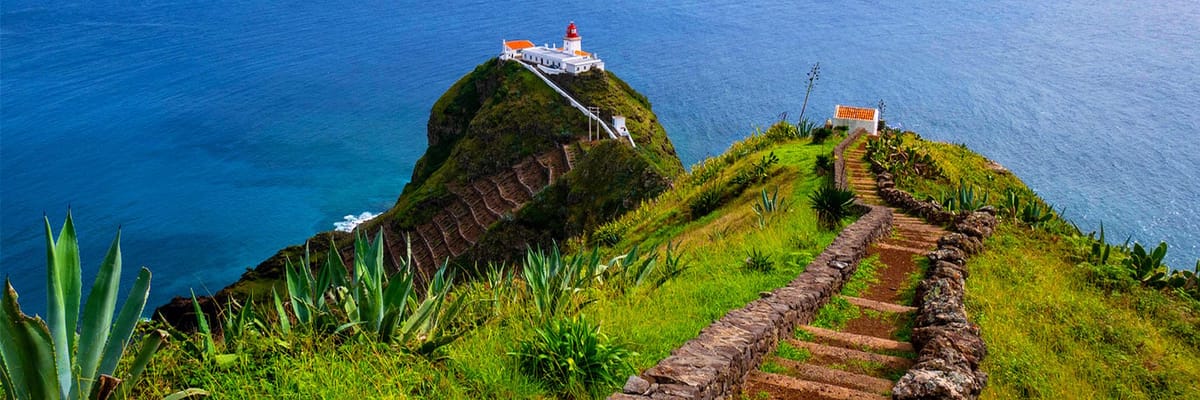
In the island’s interior, there are more than 70 km of signposted trails crossing arid volcanic landscapes, hills covered in lush forest and cliffs overlooking the Atlantic. In vineyards protected by ancient stone walls, local producers make fresh, mineral wines. This is Santa Maria. Enjoy it with TAP.
How long is the flight from Lisbon to Santa Maria?
Direct flights from Lisbon (LIS) to Santa Maria (SMA) take approximately two hours.
What is Santa Maria Airport (SMA) like?
Santa Maria Airport is small and easy to get around, and is located on the eastern side of the island. Most accommodation can be reached within 15–20 minutes by car or taxi.
When is the best time to visit Santa Maria?
Santa Maria has the driest and sunniest climate in the Azores archipelago, making it a year-round destination. Even so, the island presents clear contrasts: the southern coast is more sheltered, warmer and drier, while the north is greener and windier.
For beach holidays, the peak season runs from July to September, with water temperatures between 22–24 °C and long, sunny days. Spring (April–June) is ideal for hiking and whale watching, with fewer tourists and greener landscapes. Winter is mild, rarely below 14 °C, although the northern part of the island tends to be rainier.
Is Santa Maria good for whale watching?
Santa Maria is one of the best locations in the Azores for whale watching. The deep waters surrounding the island are home to sperm whales all year round, and depending on the season, it is also possible to encounter blue whales and several dolphin species.
The peak whale-watching season runs from March to October. Local operators organise excursions on small vessels departing from Vila do Porto, and the island’s location at the southern end of the archipelago places it in an area rich in marine life.
What makes Santa Maria unique among the islands of the Azores?
Geologically, Santa Maria is the oldest island in the Azores, formed around eight million years ago, compared with approximately 250,000 years for the island of Flores. This gives the island distinctive characteristics: erosion over millions of years created the only sandy beaches in the Azores, with Praia Formosa being the best known.
It is also the driest island in the archipelago, with a microclimate closer to the Canary Islands than to the lush green landscapes typically associated with the Azores. The island is a UNESCO Biosphere Reserve, and its fossil-rich limestone cliffs are of major scientific importance.
What is the Bay of São Lourenço and is it worth visiting?
The Bay of São Lourenço is considered one of the most beautiful bays in the Azores. Located on the northeastern coast, it is a protected natural area with clear turquoise waters, cliffs and a beach nestled between two headlands formed from volcanic rock.
It is a popular spot for snorkelling, kayaking and diving, with excellent underwater visibility. The surrounding area forms part of a protected nature reserve, and access is via a short footpath or dirt road, helping to keep the area uncrowded, even during peak season.
Does Santa Maria produce wine?
Santa Maria has a small but historically significant winemaking tradition. The white grape variety Arinto dos Açores, which is well adapted to volcanic soils, is cultivated on the island and produces fresh, mineral wines that reflect the island’s dry terroir.
The vines are trained in the traditional Azorean style—low-growing and protected by stone walls that shelter them from the Atlantic winds. Local producers can be visited, and these wines can be sampled in several restaurants in Vila do Porto, where they pair particularly well with seafood and fresh fish.
Are there good hiking trails in Santa Maria?
Santa Maria has an excellent network of signposted trails, totalling around 70 km across the island. The terrain ranges from coastal cliffs and arid volcanic landscapes in the south to forested hills in the north, offering highly varied scenery over short distances.
The trails are generally well signposted, and most routes take between two and five hours.